The snow created beautiful conditions for a series of videos -- this is the first of 3!
Wednesday, February 24, 2016

Wednesday, February 17, 2016
Queen Anne's Lace in Snow

12 x 10 inches, oil on board, 2016. Snow creates beautiful colors and compostions. My eye's always drawn to these bouquets of flowers that grace the winter fields.
$300 total (frame, shipping, and all taxes included).
Sold
Friday, April 24, 2015
Painting as Editing
Sometimes it seems less important to paint well than to be
able to determine what’s wrong, or what isn’t working, in a painting.
Same thing with writing: I’ve often felt that when it comes
to expressing myself in words, I’m a better editor than writer. Not long ago, however,
I read an article by master craftsman John McPhee about how writing IS editing. He put it this way: "The way to do a piece of writing is three or four times over, never once. For me, the hardest part comes first, getting something—anything—out in front of me. Sometimes in a nervous frenzy I just fling words as if I were flinging mud at a wall. Blurt out, heave out, babble out something—anything—as a first draft. With that, you have achieved a sort of nucleus. Then, as you work it over and alter it, you begin to shape sentences that score higher with the ear and eye."
Since then, I’ve felt a little less abashed about my muddy first drafts.
Since then, I’ve felt a little less abashed about my muddy first drafts.
Writing doesn’t work without editing, and painting doesn’t,
either. I often find myself an hour into a painting gazing at an image that
just doesn’t succeed in any way, but from long experience, I can sense that there
may be potential in it yet: that if I just make a slight change or two, it
will all come together and work confoundingly well. Other times, of course, I have to make major changes.
But the heart of the matter is knowing WHAT needs to be changed. (Or rather, suspecting: you never really know.) Also, you need to have the gumption to dive in and
change the parts that aren’t working even as you try to hold on to the good stuff.
Corot spoke of working “with confidence.” Confidence, and
hope, come into play in a big way at the moment you realize your painting has gone awry. It’s always tempting to give up entirely or to
convince yourself that what you’ve done so far can still work. I think that “how
to edit” may be the crucial skill you learn as you go on as a painter: how to
recognize problems when they arise, assess the damage, and then determine what
might work better.
You just never know at the outset of any piece what will
work for that particular composition/image/subject. You’re learning as you go each day,
and you need to learn fast—that is, by the end of your painting! So paint, then
assess, then paint, then assess. Try not to do too much assessing while you’re
painting. Constant second-guessing can get in your way.
In my rush to get done, I tend to have moments at the end of
a session when I’m able to take in the whole image at a glance. It’s as if one
minute I’m a clockmaker, drilling down on one gear, and the next I can pull
back and see how every piece connects. You may need to work long and hard to get there, but that moment is the very best time to tweak and pull each prodigal part into the fold.
Wednesday, February 25, 2015
Bearing Failure
A great quote about bearing failure by alpinist Alex Lowe that helps me keep my chin up on bad painting days: "There are people who can't bear to fail. Those people are on the short track, as far as their careers go. You have to push hard, do hard things. But you also have to be able to say, 'OK, today's not the day.'"
Monday, February 23, 2015
Tracks in Snow
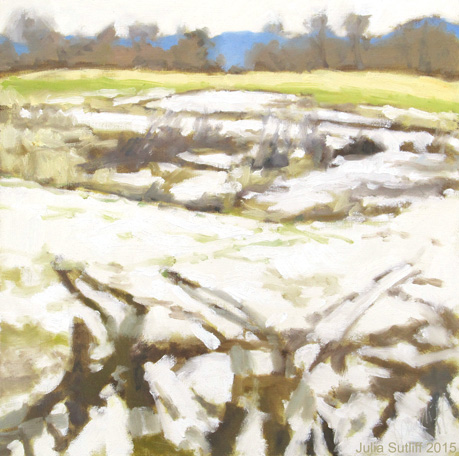
11 x 11 inches, oil on board, 2015. This scene looks peaceful but the cold wind was wicked, and I needed to stand facing into it to paint these sweeping tire tracks. Again, good for hurrying me along -- no second-guessing!
$300 total (frame, shipping, and all taxes included).
Available Please click here for purchase information.
Friday, February 20, 2015
Cold Reeds and Snow

12 x 10 inches, oil on board, 2015. Extremely cold and windy, which can be a good thing since it makes me work fast! The bright ice and snow define the beautiful forms of the cattails, and the deep blue of the shadows is so intense it reminds me of summer colors -- feels almost warm.
Sold
Tuesday, February 17, 2015
Cool Cattails

12 x 10 inches, oil on board, 2014. Painting cattails can be like putting together a puzzle: piecing together parts and connections from a jumble of shapes and tones...At the very end, almost out of time, this seemed to resolve into a balance of order and chaos.
$300 total (frame, shipping, and all taxes included).
Available Please click here for purchase information.
Subscribe to:
Posts (Atom)